

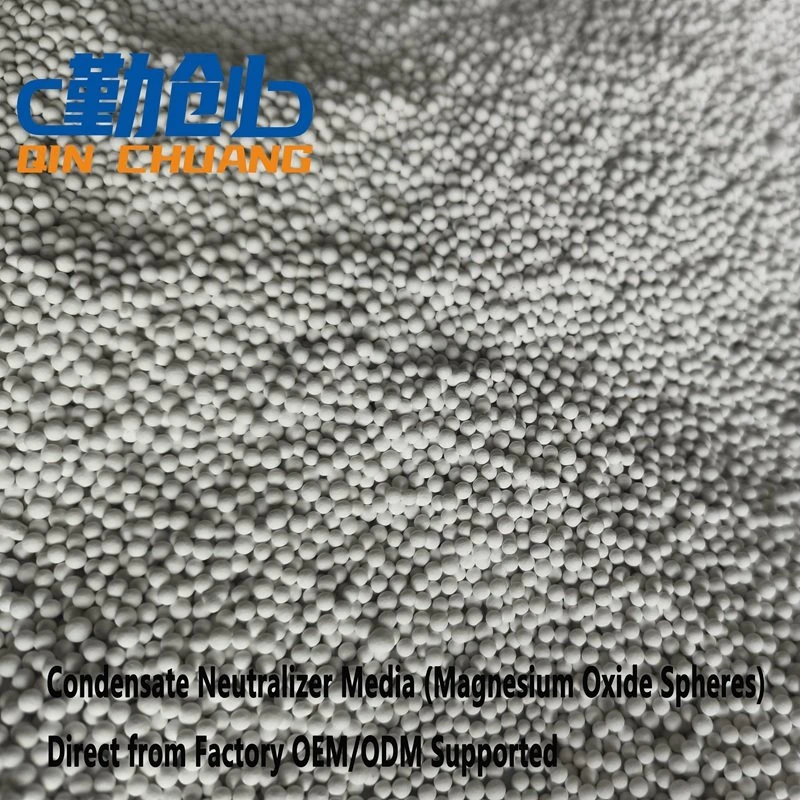


Magnesium oxide spheres are produced from high-purity magnesium oxide or sintered magnesia through pelletizing and high-temperature sintering. They feature a high melting point, high refractoriness, resistance to alkaline slag erosion, high strength, and excellent chemical stability. Key parameters-such as MgO content, particle size, bulk density, and compressive strength-can be customized. These spheres are primarily used in high-temperature, alkaline environments, including linings for iron and steel metallurgical furnaces, heat storage media, catalyst carriers, environmental desulfurization, and water treatment.
Performance Advantages
High-temperature and erosion resistance
With a melting point of approximately 2800°C, it performs stably in high-temperature, alkaline environments (such as converters, ladles, and tundishes), effectively resisting alkaline slag erosion and minimizing chemical reactions.
01
High physical strength
Crushing strength per sphere is ≥2000 N with a bulk density of 1.0–2.3 g/cm³; the material is robust and durable, resisting breakage and excessive dusting during charging and use.
02
Improved on-site operations
The spherical particle design ensures good flowability and compatibility with automatic charging equipment and gap-filling applications, resulting in less on-site dust and cleaner operations.
03
Enhanced furnace lining protection
When used for slag splashing, it effectively increases slag refractoriness and viscosity, rapidly forming a protective layer on the lining surface and extending the lining's service life.
04
Application in slag splashing for furnace lining protection
Magnesium oxide spheres can be used to adjust slag refractoriness and viscosity, promoting the formation of a protective layer on the lining surface and slowing down lining wear.
05
Production Process

The product is manufactured using highly active magnesium oxide powder as the primary raw material, combined with a specialized inorganic binder. The process involves batching and thorough mixing, high-pressure roll-forming into spheres, low-temperature curing, and screening/grading. The finished spherical granules feature high strength, resistance to pulverization, an optimized pore structure, and a stable dissolution/release rate; they effectively neutralize boiler condensate and steadily regulate pH levels, preventing excessive fluctuations in effluent pH. Throughout production, strict controls are maintained over raw material activity and pellet compressive strength to minimize breakage and the generation of suspended solids during operation, making the product ideal for use in condensate treatment tanks.
Applications
Boiler condensate neutralization material
The condensate produced by gas- or oil-fired steam boilers usually has a low pH. This product helps neutralize that acidic condensate, which in turn protects your piping and heat exchangers and helps prevent corrosion.
Condensate pH adjustment
This is a great option for neutralizing different mildly acidic water streams. It's a slow-release filter medium that takes the place of traditional alkaline chemicals, making things easier in terms of operation and maintenance. It's especially useful in industrial low-pressure steam systems, like those found in food processing, textile printing and dyeing, chemical manufacturing, and papermaking. It adjusts the condensate's pH and cuts down the risk of acid corrosion in the pipes.
Heating system condensate reuse
This system adjusts the condensate in heating heat-exchange units, improving water quality. It allows for the recovery and reuse of condensate, which helps conserve water resources.
Quality Control
Raw Material Control
We select only high-purity magnesium oxide or sintered magnesia as raw materials. Upon arrival, each batch undergoes testing for key indicators such as MgO content, SiO₂, CaO, Fe₂O₃, and loss on ignition (LOI); non-compliant materials are neither warehoused nor put into production.
01
Production Process Control
Critical control points are established at every stage, from fine grinding and classification to pelletizing and high-temperature sintering. We monitor parameters such as powder particle size, pelletization rate, green pellet bulk density, sintering temperature, and kiln speed to ensure the pellets are dense, strong, and chemically stable.
02
Finished Product Testing
We operate an independent testing laboratory equipped with a full suite of precision instruments. Each batch of magnesium oxide pellets is tested for MgO content, impurity levels, particle size distribution, bulk density, single-pellet crushing strength, and appearance. Testing methods include EDTA titration, fluorescence analysis, laser particle size analysis, and pressure testing.
03
Batch Consistency and Traceability
We have established a standardized, end-to-end quality control system. Samples are retained and complete test data recorded for every batch to ensure consistency across batches. Each batch comes with a Certificate of Analysis (COA), ensuring full traceability for customers.
04


FAQ
Q: Can magnesium oxide spheres be customized?
A: Yes. We can customize purity, particle size, bulk density, compressive strength, packaging, and certifications to suit your specific application.
Q: Can I obtain samples before placing an order?
A: Yes. We can provide samples; sample costs and shipping fees are negotiable.
Q: How do you ensure consistent quality across batches?
A: We operate an independent testing laboratory equipped with a full range of precision testing instruments and implement a comprehensive, closed-loop quality control system that covers everything from raw material selection to final product inspection.
Hot Tags: magnesium oxide spheres, China magnesium oxide spheres manufacturers, suppliers, factory


